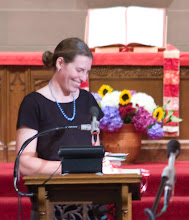
My sermon from this morning, my last morning at SMC. What a meaningful and at times emotional service it was for me (thanks, Lee for the kleenex!), and what blessings both spoken and unspoken, I carry from this place as I go.
“Imagining God as Invitation”
A word of introduction about this sermon:
As you can see in your bulletin, this sermon comes out of an intentional discussion in which several members of the congregation engaged today’s Gospel text. I am grateful for the thoughtful and creative insights of Alicia, Don, Ryan, Sandy, and John and to Amy for her gracious facilitation of our conversation. Their energy guided me toward today’s topic and contributed to much of what I say here.
Tables. End tables, card tables, coffee tables, communion tables, picnic tables, foosball tables, ping pong tables, dining room tables, kitchen tables. We eat at tables and study at them. We are taught to protect ourselves under tables during earthquakes. We have church meetings and board meetings and family meetings around tables. We find a place to put down our keys, our books, and our grocery lists on tables. Some people in this congregation can build tables. Others can decorate them with carefully chosen tablecloths or fresh flowers or elegant place settings. We set up tables for potlucks and stop, drop, and roll. Tables separate us from one another across an expanse of wood or glass or plastic, and they join us to one another as we share, in spite of our differences, the same table.
The group that brainstormed with me for this sermon shared space in couches and chairs around a table as we talked about today’s gospel text. It was a table of the smaller variety, only a couple feet high but large enough to hold a bowl of fruit and a plate of cookies, which we also shared.
Like the sermon group’s setting, the setting for today’s text is at a table. The Parable of the Great Banquet is the fourth of four stories that the writer of Luke has brought together in the context of a dinner, a Sabbath meal at the house of a leader of the Pharisees. As was custom in the ancient world, shared talk at a table was a common place for philosophers and teachers to offer their wisdom as Jesus does here. But as our sermon group quickly realized, exactly what wisdom the parable offers is far less obvious than where it takes place.
Jesus tells a story: a landowner gives a great banquet, a feast to which many are invited, but when the time comes for the banquet, the previously invited guests make excuses for why they cannot attend. The host grows angry and invites people from out on the street so the house may be filled and none who were originally invited will be able to participate in the festivities.
Perhaps the parable has historical significance as an allegory or metaphor for explaining how the Gentiles come to be included along with the Jews when God’s invitation extends to all peoples regardless of nation, tribe, or tongue. Or maybe it is about an alternative kind of justice: the people who are thought to be powerful by the world’s standards are suddenly left out and the outsiders are invited in; what seems to be the order is turned on its head. Perhaps Jesus is teaching us that in God’s kingdom, the normal social hierarchies are turned upsidedown. Or maybe the text is more about each one of us, more personal, a warning to us not to make excuses and a reminder to make time for God regardless of what else we think is important in our lives.
So which one is it? What is Jesus telling us in this parable? Is he explaining the movement of history? Is he teaching about social justice? Is he guiding us through our personal lives? Perhaps it can be any of the above depending on where we come from and how we read the text. In fact, that’s the beauty of a parable. Even biblical commentaries freely acknowledge that parables by their very nature are heard in a number of ways, even by the same person at different times. So instead of trying to tell the many people in this room how to hear this enigmatic parable, I have another suggestion for how to interact with this Scripture, a suggestion that came out clearly in our conversation as a sermon group: the parable of the great banquet for us today is about an invitation.
A few days ago I received an email invitation from the sister of a friend. My friend is getting married in Nashville next week, and her sister is quote “planning an evening of fun and festivities to celebrate Emily and her last days as a single girl.” This evening will involve eating, drinking, making merry, and probably some dancing. Now I’ll be honest. I only know about three other people who are invited (not good for my shy side), and I’m not one to casually spend my hard-earned money for the cover charge at a bar or club, AND, as always, the thought of dancing in public absolutely terrifies me. As much as I’d love to celebrate Emily, this bachelorette party thing does not sound like my idea of a good time. So what am I to do with the invitation?
Our Gospel parable for today asks us the exact same thing whether we read it historically, socially, or personally: what are we to do with the invitation?
Many of us believe that God’s invitation is unconditional, that even on our death bed or even after we die, we can choose God. God is the one who accepts us without hesitation, even if we are, like those in the story, poor, lame, blind, lost, helpless, hopeless. Most of us have learned the famous verse from Romans chapter 3: All have sinned and fall short of the glory of God and are justified by God’s gift of grace. Yes, we learn in Sunday school that God is love, that God loves us no matter what, and that would seem to say that God’s invitation is irrevocable, a call on our lives that never goes away, is always there tapping us on the shoulder, saying come to the table, come to the table, come to the banquet, come to the great dinner. And so we enter the text: isn’t the meaning of the parable clear? The person throwing the party, God, is inviting us across the span of history to a celebration, a feast in the kingdom of God.
But here’s where the problem comes in. The invitation in the parable is not unconditional. After the first guests made excuses for why they could not come, remember what the landowner said: “Compel people to come in, so that my house may be filled. For I tell you, none of those who were invited will taste my dinner.” Soon on the heels of a gracious invitation comes a harsh, rude, dare I say unreasonable dis-invitation. There is no point when the people are welcomed back to the table.
It seems there’s a contradiction here, or at least a pronounced tension. Is God unconditionally loving and inclusive? Or does God need to exclude some in order to include others? How does God’s grace fit with God’s justice?
I wish I could tell you. I wish in one sermon I could provide you a pat answer that we could tell all those people who point out the contradictions in our Christian faith, but I can’t. In fact, theologians through the ages have argued and picked apart and analyzed, and no definitive answer has emerged. Some reject works righteousness saying, we are saved through faith by grace alone. Others rail against predestination, asking what about human free will? In fact, both of these ideas, God’s grace and God’s justice, are biblical. Today I suggest one imaginative reply. I suggest that perhaps this age-old question of grace and justice, of faith and works raised by our parable is the wrong question.
My fear is that in talking about God’s justice and God’s grace, we congregants and professional theologians alike are just imposing our interpretations of the Bible and our understandings of justice and grace onto God. Author Anne Lamott says it best when she says, “You can safely assume that you’ve created God in your own image when it turns out God hates all the same people you do.”
So to return to the text, let us ask, “Who would we uninvite to our party?” Would it be the homosexuals, the transgendered, gay, lesbian, or queers? The Republicans, Democrats, or those who don't vote? Who would it be? Would it be the poor? The homeless? Those without jobs? Who would we disinvite? Would it be those who aren’t Christian? Would it be the people who don’t look like us, talk like us, dress like us, or believe like us? Would it be those who aren’t the normal we’ve come to expect here? Would we use Scripture or a God or church created in our own image to justify it?
A common interpretation of this text has supposed that the landowner in our story today is God. This interpretation ends with people cut out of the banquet. The party in the kingdom of God shuts out those who make excuses. This is the God of justice we see. But the beauty of the parable is that it is enigmatic. Jesus never says, “God gave a great dinner and invited many.” He says, “
Someone gave a great dinner and invited many…” It’s open to interpretation, and there’s another picture here of God. Turn the story on its ear for a moment of thinking imaginatively. What if God is not the landowner, or those who make excuses, or the slave who delivers the invitation, or even the poor, crippled, blind, and lame. Certainly it would be interesting to imagine God or Christ as any one of these other characters, but certainly also, God is a God of surprises who cannot be bottled into any one character or concept.
Try this. Liberate God from the characters, and make God the invitation itself. What happens then? What happens when we imagine God as invitation?
I was riding east on I-40 through Tennessee this past March on a spring break road trip to Washington DC when I got a phone call from Seattle and the Leadership Council chair here. I had inquired earlier in the winter about doing a pastoral internship at Seattle Mennonite Church between my second and third ears of seminary and was waiting with anticipation for the congregation’s decision. I answered the phone and Michael Roe said, “Hi, Sarah. On behalf of Seattle Mennonite Church, I am pleased to extend you an invitation to an internship here this summer.” When others in the church, when other churches implicitly had uninvited me, because I am a lesbian, you didn’t. And I am grateful and forever transformed by my chance to be here in your midst. It was not God who invited me; you did. It was perhaps not God’s invitation that you offered; it was yours. But in your invitation to me, in that space between us, was the real presence of God.
The invitation is that which flows between the person inviting and the person invited. It embodies the relationship between the host and the guest. And this is not so unlike our immanent, relational God, who moves in the space between us, in our love for one another and our faithfulness toward each other. When the invitation, or God is rejected, there is a breach of trust and the person inviting is left vulnerable and hurt after feeling anticipation, hope and joy. When the invitation, or God, is withdrawn, taken back by the church or another mediating party, the relationship ceases to be one of acceptance and love and those who are excluded wonder why they are suddenly unworthy.
Whether we make excuses or leave people out; whether we are the owner of five yoke of oxen or newly married; whether we are the poor, the crippled, the blind, or the lame; whether we are the master him or herself, the invitation stands, beaconing, calling us to take notice, to listen up, to pay attention to one another, for there is a banquet here. God, the invitation itself, calls to us and leads us to a dinner, a feast. When we sit down at the table, we have accepted the invitation; we have accepted God when we sit together in this space today, we have accepted the God who joins us to one another despite of and in spite of our differences. We come together through our present God at a common table. The God who gives us life is present here at the dinner, flows in the space between us, when we share our joy, our sorrow, our suffering and remorse and thanksgiving, our laughing and crying and eating. Go, noticing the God as invitation to relationship in the space between each of us, noticing the invitation that joins us together in trust, in hope, in peace, and in love. Amen.