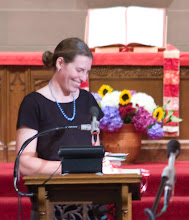
October 17, 2010
Seattle Mennonite Church
Joel 2.23-32
Have you ever been caught in a downpour?
I don’t mean the drizzle that passes for rain here in Seattle, those dry rains for which the natives don’t even pull out their umbrellas. I mean downpour – stop the car on the highway because you can’t see through the sheets of water rain. Soaked to the bone in two seconds flat rain. Thunderstorms sweeping over the Rocky Mountains and out onto the wide open plains rain. Knock you out of your normal, maybe there’s a reason humans talk so much about the weather rain. Restore the land in one afternoon after months of drought rain? Last summer there was one weekend in July when the rains came to my dad’s farm in south central Kansas. Three days it rained, and it saved the corn. A $50,000 rain, he said.
Have you ever been caught in a downpour?
The book of Joel is an overlooked part of our sacred scripture that offers a grand vision. Joel is a minor prophet, stuck between Hosea and Amos, one of those books that is hard to find when you’re looking for its three chapters within the 1,189 chapters of the Bible. But it’s an amazing book. In three short chapters Joel tells the human story of despair and repair, a story of desolation and restoration, a story we all know, one of drought and rain. By the end of chapter two, which we have heard from today, the people, the Israelites, had already been through drought, famine, and locust invasions. The country was in ruins. And in the midst of the struggle there was a clear call for repentance and prayer. And in the midst of the repentance and prayer there was a merciful response from God. Our scripture today tells of fertility restored to the ground, fruit trees bearing abundant fruit, threshing floors and wine vats filled once again, and abundant covenant blessings. And it doesn’t stop there, doesn’t stop with material restoration, for after the land is healed, so are the people. The text says:
I will pour out my spirit on all flesh.
Your sons and your daughters shall prophesy.
Your old men shall dream dreams.
And your young men shall see visions.
Even on the male and female slaves in those days I will pour out my spirit.
Ahh – it’s a grand vision, an Anabaptist vision – this is that the church can be.
The three-week worship series we begin today on empowering God’s people starts right here in Joel chapter 2 with the creative love of God generously giving gifts to all. God fills us, empowers us to follow Jesus in our words and deeds and to use our gifts in service to the church. This text from Joel, echoed later in the Pentecost story of Acts 2 is a timeless passage that captures a key message from the biblical tradition.
All flesh, all God’s people have a role. Everyone in the congregation is a leader in their own way – prophesying, dreaming dreams, seeing visions. No matter who you are or where you are on life’s journey, God calls you followers of Jesus to a vocation of faith, to a ministry in this world. By virtue of God’s spirit pouring over us, no matter our station in life, no matter our age, race, housing status, or sexual orientation, we are gifted to minister.
Oh it’s a grand vision.
And then there’s what we really are. We are busy. We are tired. We are weary. And our dreams are restless. And the visions do not come.
JENNIFER DELANTY: I am exhausted. I am so tired. I just want to sit down. I just need to rest. This past week was so stressful at work and now half the weekend is already behind me. Everything I pushed off ‘til the weekend to get done around the house still isn’t finished, and I’ve gotta go back to work tomorrow. All the bills, housework and laundry are piling up and it didn’t help that I had to spend a few hours in the office yesterday just to keep up with the dozens of files sitting on my desk. (phew!)
We barely got here to church on time this morning. Motivating the kids to leave their warm beds and get up as they have to do during the school week is a challenge. I try to let them sleep a little longer; no matter how early I get them up, we still scramble to get properly dressed and eat breakfast so we can early enough to allow 30 minutes to get to church. Usually we leave with only 15-20 minutes to spare, though, including today. Tamping down their grumpiness and disagreements sure zaps my limited energy. The dreary rain and overcast skies didn’t help, either; I wanted to stay in bed, too.
But here we are, and I’m glad we’re here. But I’m just so tired! Would anyone think less of me if I just sat here and did nothing but rest? Would anyone fault me for coming to church just so I can have one hour out of the week away from the demands of work, home, marriage and parenting? Is it OK to just be? Most of my life feels like I’m a human doing in lieu of a human being. I’m not trying to have a pity party, I’m just so exhausted and overwhelmed by all the demands!
Goodness, tears are falling out of my eyes. I am so glad I’m here. I need this place of quiet rest, near to the heart of God. Help me find Your center, dear Lord, blanket me with Your peace. Help me calm down and just be, here and now.
Have you ever been caught in a downpour? I don’t mean the irritation that comes with one bad day; I mean a downpour: the struggle of having too many things to do for the time you have; chronic unemployment and question of your own worth; mental health struggles that the world doesn’t understand; managing kids and a job and a family and church responsibilities all in the space of one life. How many of us have been there? How many of us are there? How many of us will be there again.
The great teacher and preacher Barbara Brown Taylor explains. “Affirming the ministry of every baptized Christian is not an idea that appeals to many… people these days. It sounds like more work, and most… have all the work they can do. It sounds like more responsibility, while most… are staggering under loads that are already too heavy.” She tells a short story: “I will never forget the woman who listened to my speech on the ministry of [all God’s people] and said, ‘I’m sorry, but I don’t want to be that important.’” (The Preaching Life)
Joel’s potent call to the ministry and leadership of all of God’s people can feel more like a burden than a blessing.
Unless, unless the calling is less being and doing than we realize.
One of my teenage summers, my family was on our regular vacation from Kansas to Beaver Lake in northwest Arkansas. We had been out on a boat in the water when the thunderclouds that had been forming in the west swept over that Ozarks lake and caught us in a downpour. We made our way as fast as we could to the dock, and my dad navigated us into the covered boat slip. We were safe from the downpour, sheltered under the symphony that rain makes on a tin roof. What happened next shocked my teenage self. Instead of taking off his life jacket and hurrying toward the cabin like the rest of us, my dad hopped out of the boat, took three running steps and leapt into the lake, downpour and all.
Barbara Brown Taylor continues: “Like many of those who sit beside her at church, she hears the invitation as an invitation to do more – to lead the every member canvass, or cook supper for the homeless, or teach vacation church school. Or she hears the invitation to ministry as an invitation to be more – to be more generous, more loving, more religious.” … “No one has ever introduced her to the idea that her ministry might involve being just who she already is and doing just what she already does, with one difference: namely, that she understands herself to be God’s person in and for [God’s] world.”
I will pour out my spirit on all flesh.
Your sons and your daughters shall prophesy.
Your old men shall dream dreams.
And your young men shall see visions.
Even on the male and female slaves in those days I will pour out my spirit.
This one verse, Joel 2.28, despite what our active, busy minds might hear most, is less about doing, less about being, and more about pouring. The phrase “I will pour out my spirit” bookends our call; twice God says, I will pour out my spirit onto you. The text invites us to stay a while in the creative, generous abundance of God, to not move too quickly to the prophesying and dreaming.
Just in being who you are, you are leaders, you are ministers, you are channels of the spirit of God. The call is not a call to do more. It is not a call to be more. It is a call to name and claim what you are already doing as God’s. To see God pouring her abundant gifts onto her people. To see that you, people of God, have been caught in a downpour.
So I invite you to stay a while in the pouring of the spirit. And I invite you to return to it over and over again. Let it fall upon you and drench you in two seconds flat. Let it repair and restore you. Take three steps from under your tin roof… See yourself, at least in your best moments, as God’s person and not your own.
Have you ever been caught in a downpour?
When a spare moment comes to you sitting at your desk, riding the bus, searching for a job, wrestling with addiction, sitting with your family, remember you are God’s person. And let the spirit pour.
Sunday, October 17, 2010


Saturday, October 16, 2010
What Do You See?
Thursday night I hopped on my bike to ride the approximately six miles home from Lake City to Crown Hill, from northeast to northwest Seattle. It was about 10 p.m. and the Pastoral Care Team meeting at Seattle Mennonite Church had ended in time for me to finish up Sunday's worship order, send out an announcement for the "communicator" and gather up my sermon materials for writing and editing the next day. I've come to appreciate these night rides, when the traffic is light and the city is peaceful.
I pulled out of the courtyard onto 125th, and while I was waiting at the light to turn left onto Lake City Way, I noticed three teenage boys standing around a middle-age woman off of the corner between the bus stop and the ATM. I looked again and realized I had met the woman before, either at the drop-in or on the street. I looked again and realized, as the three boys walked away, that a transaction had just happened.
There's a man who I've come to know over the last few years of being around the church. He's a big man, sometimes loud and intimidating, sometimes overbearing and in my bubble space, sometimes charismatic and generally friendly. In our conversations, "Dan" will occasionally mention that he saw me the other day. Then he'll add, "But you didn't see me." He's right. I didn't see him. And because I didn't see him, I couldn't see him. Occasionally he'll go on to say, "We're everywhere. Do you see us?"
So much depends on where we look and how we look.
Outside the Greenwood library the other day there were two people, a man and a woman smoking. I passed by them and smelled alcohol from about ten feet away. My instinct, my gut reaction was to look away, to pretend like I didn't see, to go on with my business, and to forget they were there. To walk past the lingering smell into fresh, pure air and to forget about their second hand clothes. To cycle comfortably on into my own privilege, my small and heated apartment, my meaningful work. To never be changed and formed, to never be disrupted.
I'm six and a half weeks into my year as a Mennonite pastor. Each week I see something new. Of course there are the worship experiences, the meetings, the joyous time with our youth, the visioning and listening and accompanying tasks of the pastor. But my true formation as a person of God is wrapped somehow into the transaction Thursday night off the corner of 125th and Lake City Way. I'm not sure what that means yet, but the question persists: what do you see?
I pulled out of the courtyard onto 125th, and while I was waiting at the light to turn left onto Lake City Way, I noticed three teenage boys standing around a middle-age woman off of the corner between the bus stop and the ATM. I looked again and realized I had met the woman before, either at the drop-in or on the street. I looked again and realized, as the three boys walked away, that a transaction had just happened.
There's a man who I've come to know over the last few years of being around the church. He's a big man, sometimes loud and intimidating, sometimes overbearing and in my bubble space, sometimes charismatic and generally friendly. In our conversations, "Dan" will occasionally mention that he saw me the other day. Then he'll add, "But you didn't see me." He's right. I didn't see him. And because I didn't see him, I couldn't see him. Occasionally he'll go on to say, "We're everywhere. Do you see us?"
So much depends on where we look and how we look.
Outside the Greenwood library the other day there were two people, a man and a woman smoking. I passed by them and smelled alcohol from about ten feet away. My instinct, my gut reaction was to look away, to pretend like I didn't see, to go on with my business, and to forget they were there. To walk past the lingering smell into fresh, pure air and to forget about their second hand clothes. To cycle comfortably on into my own privilege, my small and heated apartment, my meaningful work. To never be changed and formed, to never be disrupted.
I'm six and a half weeks into my year as a Mennonite pastor. Each week I see something new. Of course there are the worship experiences, the meetings, the joyous time with our youth, the visioning and listening and accompanying tasks of the pastor. But my true formation as a person of God is wrapped somehow into the transaction Thursday night off the corner of 125th and Lake City Way. I'm not sure what that means yet, but the question persists: what do you see?
Sunday, September 19, 2010
The Word becomes
Seattle Mennonite Church
September 19, 2010
We turn our attention to the convictions that connect us as a global Mennonite community, beyond the Pacific Northwest Conference and beyond Mennonite Church USA to include the worldwide communion of those who practice the Mennonite faith.
As Melanie has reminded us, today is the second Sunday in our series “Believing Together.” We continue to turn our attention to the convictions that connect us as a global Mennonite community, beyond the Pacific Northwest Conference and beyond Mennonite Church USA to include the worldwide communion of those who practice the Mennonite faith.
Last week our worship celebrated the triune expression of God as creator, Christ, and spirit. Weldon began the sermon time by posing this question to us: “If someone asked, ‘Do you believe in one God or three gods?’ how would you answer?” Someone very witty and clever sitting in my vicinity simply answered, “Yes.” I, on the other hand, was stumped and quickly bumbled through a long series of questions in my head, which of course remain unresolved. Ah the mysteries of our faith.
This week in believing together we turn to our sacred text, the Bible as authority for faith and life. So I want to begin by saying right from the get-go – the scripture as authority for our obedience – no less a mystery, no less the object of confusion, no less deserving of bumbling responses. And so with that, Lord please bless the speaking and hearing of this word.
Today as a congregation we affirmed the authority of scripture in this place and beyond. Consider for example some of today’s bumper sticker theology:
In many ways this reverence for scripture was the trademark of the Protestant Reformation that began in the first half of the sixteenth century, nearly 500 years ago. Religious reformers began to pull away from the comprehensive authority of the Roman Catholic Church, insisting that scripture alone was the authority for faith. Anyone could read scripture; anyone could meet God in the Bible; anyone could interpret the mysteries of the faith.
The early Anabaptists were the most radical of the breakaway groups, insisting even more stringently on the literal authority of scripture for faith and life. One of the early leaders, Menno Simons, for whom we Mennonites are named wrote in 1539-40, “No one of a rational mind will be so foolish as to deny that the whole Scriptures, both the Old and New Testament, were written for our instruction, admonition, and correction, and that they are the true scepter and rule by which the Lord’s kingdom, house, church, and congregation must be ruled and governed.” He goes on to say, “Everything contrary to Scripture, therefore, whether it be doctrines, beliefs, sacraments, worship, or life, should be measured by this infallible rule.” (from Foundation of Christian Doctrine) The Word becomes infallible rule.
Menno Simons understood his life, his personhood, his experiences in the world through the framework of scripture. And other Anabaptists did as well, literally immersing their lives in the biblical texts. As the stories go, untrained lay brethren easily matched wits with trained doctors of theology who questioned them about scripture. Some folks made it their goal to memorize one hundred chapters of the New Testament, which is equivalent to Matthew, Mark, Luke, John, Philippians, Colossians, and 2 Timothy. Really – can you imagine? Indeed profound affirmations of the authority of scripture are writ large on our history as a people.
But a recent article in our denomination’s monthly periodical describes a vastly different Mennonite biblical landscape. Mennonite professors lament decreasing biblical literacy among their incoming college students, students who don’t know the story, how the pieces of our sacred scripture fit together. Young people, or maybe all people are not receiving the comprehensive biblical formation needed to carry on the Biblicism, the reverence for scripture of those who have come before. Some would say it’s the end of our faith as we know it.
And no wonder, for the Bible looks different than it used to. Thanks to a couple of centuries of biblical scholarship, we know that the Bible was composed over many years by many authors from many different places. We know that none of the original manuscripts exist today and that many of the first manuscripts were the second or third version of oral histories, each account tweaked or adapted in some way. We know that different, even contradictory perspectives are captured in these texts. not to mention the books that didn’t make it into the Bible, not to mention the fact that the canon, our 66 books of scripture, was not set until the year 367, nearly three hundred years after the latest book was written. And besides all these textual and canonical and historical inconsistencies and puzzles, there are the theological ones:
Our sacred scripture, our beloved Bible, our rule for faith and life has decisively patriarchal narratives, stories of colonialism and domination, religious exclusivism and persecution of those who think or believe differently. It is at times homophobic, racist, xenophobic, and exceedingly violent. At other times it is baffling, and that at worst – at absolute worst, it seems irrelevant, with nothing to say for our time and this place. The Word becomes oppressive, the Word becomes dangerous, the Word becomes disconnected from our experiences as human beings.
There are certainly biblical scholars, theologians, and otherwise devoted people some in our midst today, who dig into the text with profound wisdom, who sort through these difficulties for the keys to our faith. But for many of us, when we look at the formation of our sacred scriptures, and when we hold up our biggest questions to them, these sacred Words of God don’t seem so sacred. They don’t seem inspired. They don’t even seem like they matter. In fact, our anxious response is often to disengage, to shut down and stop asking the questions, to leave the Bible to the experts and to turn to something that seems more immediate and more important for our lives.
Do we give up on the Bible? Do we look for a better book? Do we cut out the disturbing parts? Do we simply hang on to our favorite themes and discard the rest? Is it the end of our biblical faith as we once knew it? What’s a modern Mennonite to do?
This morning may I suggest that we start again at the beginning.
John chapter one: In the beginning there was the Word; the Word was in God’s presence, and the Word was God. The Word was present to God from the beginning. Through the Word all things came into being… Through the Word was life and the Word took on flesh.
From the very beginning, words were important. In the first creation account, Genesis chapter 1, in the beginning God created by speaking words: “And God said, ‘Let the be light..’ And there was light.” Words, these words of ours are important.
John chapter one again – In the beginning there was the Word. Through the Word was life and the Word took on flesh. You know what happens when Words take on flesh. When the eternal is thrust into the temporal, when ideas and dreams fall into reality and the text comes off the page. You know that flesh covers bones and muscles, which break and scrape and tear. Flesh is something you feel with your own hands and see with your own eyes. Word become flesh doubts and cries and bleeds and later is crucified.
We are people of the Word. Without the Word, we are not a people. Our scripture is not sacred and authoritative because each letter and verse is true or because it was dictated by the holy spirit or because it is a decree for how we should live. The Bible is not a flesh free of scars or sins, and yes it is filled with contradictions. Yet it is authoritative because from the beginning we came to it, and today to the Word we return, seeking a fresh interpretation.
Each time we open this sacred book the Word becomes again, for each time we open it our own flesh has changed, hearts that carry a new scar or souls that sing a new joy. It is not what the Word becomes. It is that it becomes again and again. And each time we come, we are welcomed to come again, to pose a new question and let the spirit uncover a new possibility for interpretation.
The Word of God is more dynamic than we ever thought possible and more inclusive than we’ve been taught before. The horizon of the text stretches from the 1st century to today and beyond. And the Word still acts upon us as we look to Jesus as a model for discipleship, for thinking and acting in the world. As we find comfort in the words of the Psalms or advice or instruction in one of Paul’s epistle or a story of justice in the prophets of old. The Word still acts upon us we ask of it our most difficult questions and ask them again and again. There’s some inspiration in this, something life-affirming here, something that encourages wholeness and brings us closer to our best forms of being together.
We are co-creators in this Word as with each interpretation it becomes flesh again. No question is to great, no struggle too small – all that is required is that we come again to be the people of the Word.
September 19, 2010
We turn our attention to the convictions that connect us as a global Mennonite community, beyond the Pacific Northwest Conference and beyond Mennonite Church USA to include the worldwide communion of those who practice the Mennonite faith.
As Melanie has reminded us, today is the second Sunday in our series “Believing Together.” We continue to turn our attention to the convictions that connect us as a global Mennonite community, beyond the Pacific Northwest Conference and beyond Mennonite Church USA to include the worldwide communion of those who practice the Mennonite faith.
Last week our worship celebrated the triune expression of God as creator, Christ, and spirit. Weldon began the sermon time by posing this question to us: “If someone asked, ‘Do you believe in one God or three gods?’ how would you answer?” Someone very witty and clever sitting in my vicinity simply answered, “Yes.” I, on the other hand, was stumped and quickly bumbled through a long series of questions in my head, which of course remain unresolved. Ah the mysteries of our faith.
This week in believing together we turn to our sacred text, the Bible as authority for faith and life. So I want to begin by saying right from the get-go – the scripture as authority for our obedience – no less a mystery, no less the object of confusion, no less deserving of bumbling responses. And so with that, Lord please bless the speaking and hearing of this word.
Today as a congregation we affirmed the authority of scripture in this place and beyond. Consider for example some of today’s bumper sticker theology:
- BIBLE: Basic Instructions Before Leaving Earth
- Or how about this one: “If your Bible is falling apart, chances are that your life is staying together.”
- Oh, and there’s the church sign that says, “Get off Facebook and get into my book. – God”
In many ways this reverence for scripture was the trademark of the Protestant Reformation that began in the first half of the sixteenth century, nearly 500 years ago. Religious reformers began to pull away from the comprehensive authority of the Roman Catholic Church, insisting that scripture alone was the authority for faith. Anyone could read scripture; anyone could meet God in the Bible; anyone could interpret the mysteries of the faith.
The early Anabaptists were the most radical of the breakaway groups, insisting even more stringently on the literal authority of scripture for faith and life. One of the early leaders, Menno Simons, for whom we Mennonites are named wrote in 1539-40, “No one of a rational mind will be so foolish as to deny that the whole Scriptures, both the Old and New Testament, were written for our instruction, admonition, and correction, and that they are the true scepter and rule by which the Lord’s kingdom, house, church, and congregation must be ruled and governed.” He goes on to say, “Everything contrary to Scripture, therefore, whether it be doctrines, beliefs, sacraments, worship, or life, should be measured by this infallible rule.” (from Foundation of Christian Doctrine) The Word becomes infallible rule.
Menno Simons understood his life, his personhood, his experiences in the world through the framework of scripture. And other Anabaptists did as well, literally immersing their lives in the biblical texts. As the stories go, untrained lay brethren easily matched wits with trained doctors of theology who questioned them about scripture. Some folks made it their goal to memorize one hundred chapters of the New Testament, which is equivalent to Matthew, Mark, Luke, John, Philippians, Colossians, and 2 Timothy. Really – can you imagine? Indeed profound affirmations of the authority of scripture are writ large on our history as a people.
But a recent article in our denomination’s monthly periodical describes a vastly different Mennonite biblical landscape. Mennonite professors lament decreasing biblical literacy among their incoming college students, students who don’t know the story, how the pieces of our sacred scripture fit together. Young people, or maybe all people are not receiving the comprehensive biblical formation needed to carry on the Biblicism, the reverence for scripture of those who have come before. Some would say it’s the end of our faith as we know it.
And no wonder, for the Bible looks different than it used to. Thanks to a couple of centuries of biblical scholarship, we know that the Bible was composed over many years by many authors from many different places. We know that none of the original manuscripts exist today and that many of the first manuscripts were the second or third version of oral histories, each account tweaked or adapted in some way. We know that different, even contradictory perspectives are captured in these texts. not to mention the books that didn’t make it into the Bible, not to mention the fact that the canon, our 66 books of scripture, was not set until the year 367, nearly three hundred years after the latest book was written. And besides all these textual and canonical and historical inconsistencies and puzzles, there are the theological ones:
Our sacred scripture, our beloved Bible, our rule for faith and life has decisively patriarchal narratives, stories of colonialism and domination, religious exclusivism and persecution of those who think or believe differently. It is at times homophobic, racist, xenophobic, and exceedingly violent. At other times it is baffling, and that at worst – at absolute worst, it seems irrelevant, with nothing to say for our time and this place. The Word becomes oppressive, the Word becomes dangerous, the Word becomes disconnected from our experiences as human beings.
There are certainly biblical scholars, theologians, and otherwise devoted people some in our midst today, who dig into the text with profound wisdom, who sort through these difficulties for the keys to our faith. But for many of us, when we look at the formation of our sacred scriptures, and when we hold up our biggest questions to them, these sacred Words of God don’t seem so sacred. They don’t seem inspired. They don’t even seem like they matter. In fact, our anxious response is often to disengage, to shut down and stop asking the questions, to leave the Bible to the experts and to turn to something that seems more immediate and more important for our lives.
Do we give up on the Bible? Do we look for a better book? Do we cut out the disturbing parts? Do we simply hang on to our favorite themes and discard the rest? Is it the end of our biblical faith as we once knew it? What’s a modern Mennonite to do?
This morning may I suggest that we start again at the beginning.
John chapter one: In the beginning there was the Word; the Word was in God’s presence, and the Word was God. The Word was present to God from the beginning. Through the Word all things came into being… Through the Word was life and the Word took on flesh.
From the very beginning, words were important. In the first creation account, Genesis chapter 1, in the beginning God created by speaking words: “And God said, ‘Let the be light..’ And there was light.” Words, these words of ours are important.
John chapter one again – In the beginning there was the Word. Through the Word was life and the Word took on flesh. You know what happens when Words take on flesh. When the eternal is thrust into the temporal, when ideas and dreams fall into reality and the text comes off the page. You know that flesh covers bones and muscles, which break and scrape and tear. Flesh is something you feel with your own hands and see with your own eyes. Word become flesh doubts and cries and bleeds and later is crucified.
We are people of the Word. Without the Word, we are not a people. Our scripture is not sacred and authoritative because each letter and verse is true or because it was dictated by the holy spirit or because it is a decree for how we should live. The Bible is not a flesh free of scars or sins, and yes it is filled with contradictions. Yet it is authoritative because from the beginning we came to it, and today to the Word we return, seeking a fresh interpretation.
Each time we open this sacred book the Word becomes again, for each time we open it our own flesh has changed, hearts that carry a new scar or souls that sing a new joy. It is not what the Word becomes. It is that it becomes again and again. And each time we come, we are welcomed to come again, to pose a new question and let the spirit uncover a new possibility for interpretation.
The Word of God is more dynamic than we ever thought possible and more inclusive than we’ve been taught before. The horizon of the text stretches from the 1st century to today and beyond. And the Word still acts upon us as we look to Jesus as a model for discipleship, for thinking and acting in the world. As we find comfort in the words of the Psalms or advice or instruction in one of Paul’s epistle or a story of justice in the prophets of old. The Word still acts upon us we ask of it our most difficult questions and ask them again and again. There’s some inspiration in this, something life-affirming here, something that encourages wholeness and brings us closer to our best forms of being together.
We are co-creators in this Word as with each interpretation it becomes flesh again. No question is to great, no struggle too small – all that is required is that we come again to be the people of the Word.
Saturday, July 10, 2010
A little update...
It's been a wild few weeks.
The senior minister at the church where I work is taking a family leave of absence, which has vaulted me into worship and pastoral care roles at church. Here are some of the fruits of my labor:
"Our Determined Hope"
(June 17, 2010)
"Harvest Time"
(July 4, 2010)
You can listen to the sermons by clicking on the link on the left side of the page.
We've also started chicken- and house-sitting for Rob and Lee while they are cavorting around the country on their Great American Road Trip. It is a joy to mow the lawn and do the watering. I'm not being facetious. I really enjoy doing these things.
AND, Megan and Brad spent an adventure-filled week with us that included things like...
 ... axing crabs on a chopping block. This was after we went out on the Puget Sound in Kevin and Nancy's boat, the Frankie R. (namesake: Francis Regier/Horan, our great aunt and Grandma Donna's sister). We pulled up the pots Kevin had set early that morning, coincidentally the opening day of crabbing season, Dungeness in case you're wondering. Then we selected the biggest ones, took them home, killed and cleaned them, grilled them, and feasted on the succulent white meat.
 ... visiting the cloud enshrouded Mount St. Helens. It's prime Bigfoot country out there, and we think we may have seen traces of the elusive Sasquatch. We never did see the top of the mountain, though.
 ... a trip to the majestic and freezing cold Pacific Ocean. It was Brad's first ever glimpse of salt water, and we experienced childhood once again, collecting pretty rocks and sand dollars on the beach.
 The trip also included obligatory trips into the kitschy tourist shops in Westport and the traditional purchase of saltwater taffy.

... and finally we had the pleasure of seeing the Kansas City Royals beat the lowly Seattle Mariners. It was fun to be in Seattle and see Kansas fan gear, including a few folks in Jayhawks t-shirts.
All photo credits to Megan, who no doubt will be adding some of her own blog updates about the Kohlman's adventure to the wild Pacific Northwest.
In other news, it appears that summer sun is here to stay in Seattle. Finally. One squash is growing in my container garden, and the tomato plant is poised for summer abundance. I have two containers filled with fallow land after the carrots and lettuce have been eaten and the vegetable waste plowed under to return some nutrients to the soil, maybe. We're accepting all suggestions for summer grilling that doesn't involve meat (Jamie's a vegetarian), because it's simply not healthy to be using the oven or stove in this hot weather, living without air conditioning above a garage and all.
Tomorrow we have more relatives coming out for a visit and in a week and a half, people will begin to converge here to celebrate Jamie's ordination as minister in the Christian Church (Disciples of Christ). Then I'll be taking 16 youth on a mission trip to the Yakama Christian Mission, and THEN we'll be headed to Kansas and Arkansas for summer vacation the first week in August. Good times.
The senior minister at the church where I work is taking a family leave of absence, which has vaulted me into worship and pastoral care roles at church. Here are some of the fruits of my labor:
"Our Determined Hope"
(June 17, 2010)
"Harvest Time"
(July 4, 2010)
You can listen to the sermons by clicking on the link on the left side of the page.
We've also started chicken- and house-sitting for Rob and Lee while they are cavorting around the country on their Great American Road Trip. It is a joy to mow the lawn and do the watering. I'm not being facetious. I really enjoy doing these things.
AND, Megan and Brad spent an adventure-filled week with us that included things like...


... and finally we had the pleasure of seeing the Kansas City Royals beat the lowly Seattle Mariners. It was fun to be in Seattle and see Kansas fan gear, including a few folks in Jayhawks t-shirts.
All photo credits to Megan, who no doubt will be adding some of her own blog updates about the Kohlman's adventure to the wild Pacific Northwest.
In other news, it appears that summer sun is here to stay in Seattle. Finally. One squash is growing in my container garden, and the tomato plant is poised for summer abundance. I have two containers filled with fallow land after the carrots and lettuce have been eaten and the vegetable waste plowed under to return some nutrients to the soil, maybe. We're accepting all suggestions for summer grilling that doesn't involve meat (Jamie's a vegetarian), because it's simply not healthy to be using the oven or stove in this hot weather, living without air conditioning above a garage and all.
Tomorrow we have more relatives coming out for a visit and in a week and a half, people will begin to converge here to celebrate Jamie's ordination as minister in the Christian Church (Disciples of Christ). Then I'll be taking 16 youth on a mission trip to the Yakama Christian Mission, and THEN we'll be headed to Kansas and Arkansas for summer vacation the first week in August. Good times.
Monday, June 7, 2010
The Sacred Pilgrimage
My favorite day of the week is Monday.
Monday is the day in which I take my sacred pilgrimage to acquire food for the week. I dream some day of balancing my consumption with production, of some day taking my sacred pilgrimage out to a large garden or down to a pantry stocked with foods grown by God and picked, prepared, and dried or canned by my own two hands. For now I get to choose between Safeway, QFC, Lenny's Produce, and the new Grocery Outlet.
After my sophomore year of college I moved out of the dorms with their convenient cafeteria fare and into my first apartment at 949 S. Kickapoo in Springfield, Missouri. Those were the old days when Buzz and I rented a two bedroom apartment for $375 a month. Those were also the days when I began to love shopping for groceries. The options were fewer there, and I went up the road to the Dillons on National Avenue just a mile or so north of the university. I'd start with the staples: cheese, yogurt, bread and then wind my way around the store in orderly fashion.
But come to think of it, perhaps I began loving the grocery store longer ago. My brave mother used to take the four of us kids along with her into town. We'd stock up, literally a grocery cart piled to the brim. A family of six goes through a lot of food in a week, and from the farm we couldn't just walk over to get some more margarine like Jamie and I often do today. Mom would deploy us on little missions through the store, the ever-moving cart being the home base. Sometimes it was scary to go to the next aisle over. I much preferred jumping over the tan tiles on the Dillons floor, staying within sight of mom.
I didn't realize it back then, but getting to know a grocery store is like getting to know a person. It happens over time, and there are many layers, high and low, front to back. I've learned to reach behind the front row of milk to the fresher stuff because there's no way I can drink half a gallon in just three or four days. I've learned there were some things I just have to ask about, though often that has involved my shy self calling mom or one of my grandmas before talking to a store employee. In fact, I still remember Grandma Lu directing me to the hominy that was to later star in that week's white chicken chili.
Getting to know a grocery store is like getting to know a place too. You weave in and out of the aisles, tying yourself to the shelves and the walls and the tiles on the floor. A store has a certain smell and plays a certain kind of generic music, even when the music is completely ill-fitted to the culture of the neighborhood. Some stores, usually in lower income neighborhoods, have bruised produce that you have to sort through and that remind you of your participation in systems of domination and oppression.
It's disorienting to be in a new grocery store, but after a while you get to know the place. You learn to buy things on sale. You learn when the store brand is just fine and when you need to pay the fifty cents extra for the name brand. You learn the people who work there, for sure by face and if you're not shy, perhaps by name and other things. They recognize you too, at least if you're like me and wear the same pair of sweats and baseball cap every Monday morning.
A new favorite singer/songwriter of mine is Carrie Newcomer. She's a Midwestern folksinger, a Quaker with deep spiritual roots, a strong sense of place, and a gift for expressing the profound. She has a song called "Holy As A Day is Spent." It doesn't mention buying food, but it might as well for the sacredness it finds in our pilgrimages through the ordinary.
Monday is the day in which I take my sacred pilgrimage to acquire food for the week. I dream some day of balancing my consumption with production, of some day taking my sacred pilgrimage out to a large garden or down to a pantry stocked with foods grown by God and picked, prepared, and dried or canned by my own two hands. For now I get to choose between Safeway, QFC, Lenny's Produce, and the new Grocery Outlet.
After my sophomore year of college I moved out of the dorms with their convenient cafeteria fare and into my first apartment at 949 S. Kickapoo in Springfield, Missouri. Those were the old days when Buzz and I rented a two bedroom apartment for $375 a month. Those were also the days when I began to love shopping for groceries. The options were fewer there, and I went up the road to the Dillons on National Avenue just a mile or so north of the university. I'd start with the staples: cheese, yogurt, bread and then wind my way around the store in orderly fashion.
But come to think of it, perhaps I began loving the grocery store longer ago. My brave mother used to take the four of us kids along with her into town. We'd stock up, literally a grocery cart piled to the brim. A family of six goes through a lot of food in a week, and from the farm we couldn't just walk over to get some more margarine like Jamie and I often do today. Mom would deploy us on little missions through the store, the ever-moving cart being the home base. Sometimes it was scary to go to the next aisle over. I much preferred jumping over the tan tiles on the Dillons floor, staying within sight of mom.
I didn't realize it back then, but getting to know a grocery store is like getting to know a person. It happens over time, and there are many layers, high and low, front to back. I've learned to reach behind the front row of milk to the fresher stuff because there's no way I can drink half a gallon in just three or four days. I've learned there were some things I just have to ask about, though often that has involved my shy self calling mom or one of my grandmas before talking to a store employee. In fact, I still remember Grandma Lu directing me to the hominy that was to later star in that week's white chicken chili.
Getting to know a grocery store is like getting to know a place too. You weave in and out of the aisles, tying yourself to the shelves and the walls and the tiles on the floor. A store has a certain smell and plays a certain kind of generic music, even when the music is completely ill-fitted to the culture of the neighborhood. Some stores, usually in lower income neighborhoods, have bruised produce that you have to sort through and that remind you of your participation in systems of domination and oppression.
It's disorienting to be in a new grocery store, but after a while you get to know the place. You learn to buy things on sale. You learn when the store brand is just fine and when you need to pay the fifty cents extra for the name brand. You learn the people who work there, for sure by face and if you're not shy, perhaps by name and other things. They recognize you too, at least if you're like me and wear the same pair of sweats and baseball cap every Monday morning.
A new favorite singer/songwriter of mine is Carrie Newcomer. She's a Midwestern folksinger, a Quaker with deep spiritual roots, a strong sense of place, and a gift for expressing the profound. She has a song called "Holy As A Day is Spent." It doesn't mention buying food, but it might as well for the sacredness it finds in our pilgrimages through the ordinary.
Subscribe to:
Posts (Atom)